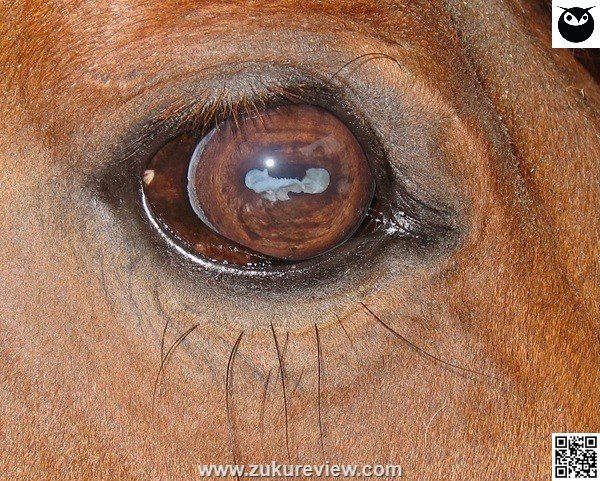
This is a cataract, and the most common etiology in adult horses is equine recurrent uveitis. Most horses with recurrent uveitis eventually develop some degree of cataracts. There are also some ventral posterior synechiae visible in this image.
Signs of uveitis (previous or ongoing) include aqueous flare, iris corpora nigra atrophy, fibropupillary membranes, and posterior synechiae. Active flare-ups of uveitis present with corneal edema, blepharospasm, epiphora, and miosis.
In foals, cataracts are most often developmental or congenital. Congenital cataracts are the most common congenital abnormality in foals.
The only Tx for cataracts is surgical removal (e.g., phacoemulsification) – performed if there is visual impairment in cases not secondary to uveitis.
Check out this great slide show with lots of images on Equine Lens Problems, courtesy of Dr. Dennis Brooks at the University of Florida.
Image courtesy of Nora Grenager, VMD, DACVIM.