


September marks an important point in NAVLE® preparation. With the October-November testing window approaching, the next several weeks offer an opportunity to turn the knowledge you’ve built throughout veterinary school into focused, exam-ready preparation.
Your study strategy should evolve as your test date approaches. September is a time to strengthen clinical knowledge and practice applying it across species and disciplines. As exam day gets closer, shift more attention toward mixed practice, clinical reasoning, testing endurance, and focused reinforcement.
Zuku Review can support that progression with structured practice, progress tracking, alignment to the updated NAVLE® experience, and tools to identify areas that need more attention.
Here’s how to make each phase count.
September: Progress from Review to Application
Use September to transition from reviewing veterinary knowledge to applying it in clinical scenarios. You may still need content review, especially for species or disciplines you haven’t encountered recently. But instead of relying primarily on rereading notes or watching lectures, use active recall to test what you can retrieve without prompts.
When you review a disease, work through it as a clinical problem like you would in practice:
Signalment → history → clinical signs → differential diagnoses → diagnostics → management and prognosis
Can you recognize the disease if a question did not name it directly? Which findings make you suspect it? What other conditions could produce a similar presentation? Which diagnostic or management step would come next?
Zuku’s NAVLE® practice questions can help you make this transition by challenging you to apply veterinary knowledge in question-based scenarios. Focus less on how many questions you complete and more on whether you can use clinical information to reach a decision.
Your September priorities:
- Continue targeted content review where needed
- Use active recall (quizzing yourself) instead of relying on passive skimming
- Practice interpreting clinical case information
- Connect diseases with diagnostics, treatment, and management
- Strengthen clinical reasoning in less familiar topics/species
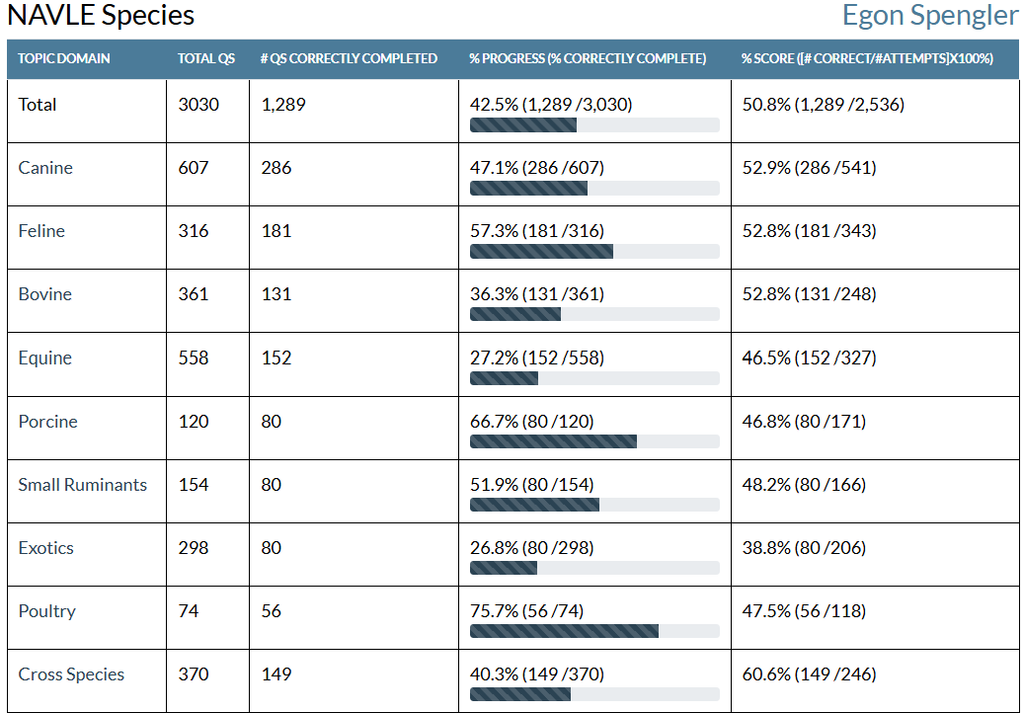
Use your Zuku performance to identify specialties and topics that require additional review.
Late September and Early October: Integrate Across Species and Disciplines
As test day gets closer, increase the complexity of your practice. The NAVLE® requires you to shift repeatedly between species, body systems, and disciplines. For example, you might encounter canine endocrinology followed by equine lameness, bovine reproduction, feline infectious disease, or pharmacology. Your preparation should begin reflecting that variety.
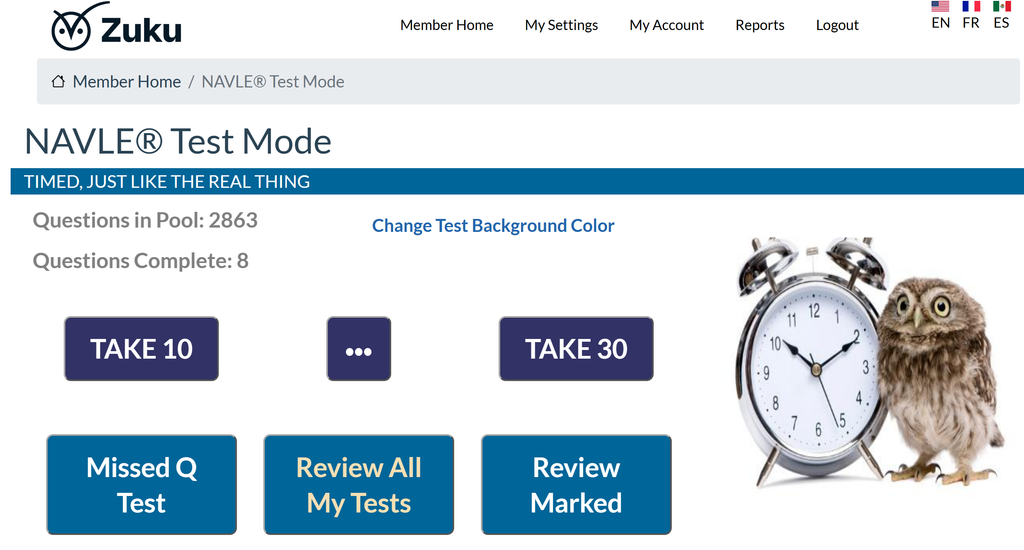
Do mixed-question sessions to practice making those transitions without knowing which subject comes next. Use your Zuku performance tracking to guide what you review next, turning practice into a feedback loop.

Mixed practice like this challenges you to identify what matters in a case, select the appropriate clinical framework, and retrieve relevant knowledge from a broad pool of information. As you review mixed sets, ask yourself:
- How quickly did I recognize the species- or discipline-specific clues?
- Could I shift efficiently from one type of case to another?
- Which subjects consistently slowed my decision-making?
- Did I confuse similar diseases or treatments across species?
- Where do I need more practice integrating information?
Look for patterns across an entire question set rather than treating every missed question as an isolated problem. If your results repeatedly point to the same species, discipline, or type of clinical decision, prioritize that area in your next study session.
October: Let Your Test Date Set the Pace
By October, your strategy should depend heavily on your individual NAVLE® date.
If You Test in October:
Narrow your preparation to mixed-question practice, recurring trouble spots, and concepts you want to reinforce before exam day.
Longer practice sessions can also help you prepare for sustained concentration. Instead of focusing only on whether you answered correctly, pay attention to how your decision-making changes as you become tired.
Study strategically rather than trying to cover everything. Avoid relearning entire disciplines during your final weeks. Use your remaining time to reinforce knowledge that can improve your performance across multiple clinical scenarios.
If You Test in November:
October gives you more time for intensive application. Continue mixed practice while addressing areas that consistently challenge you. Increase the length of some question sessions and use targeted content review when your performance uncovers a knowledge gap.
Zuku progress tracking can help you decide where to direct any extra time. Instead of reviewing every topic equally, let your performance guide your priorities.
Your Final 2-3 Weeks: Reinforce and Build Exam Readiness
The closer you get to exam day, the more selective your studying should become. This isn’t the time to add several new resources or create a completely different study system. Focus on strengthening what you’ve already learned while also preparing for the demands of the exam itself.
Prioritize:
- Mixed, randomized-topic practice across species and disciplines
- Frequently missed concepts
- Important clinical associations
- Diagnostic and treatment principles
- Species that still need reinforcement
- Time management and strategic guessing when you don’t know the answer
- Efficient clinical decision-making
Use longer practice sessions with multiple question blocks to build stamina and practice maintaining your pace as fatigue sets in. Zuku’s 180- and 300-question readiness tests can help you evaluate your knowledge while practicing the pacing, concentration, and topic switching required on the NAVLE ®.
If a practice question exposes a gap, address the specific concept. Don’t turn one incorrect answer into hours of a deep dive review.
Keep returning to the clinical reasoning process: interpret the information in front of you, identify the most likely differentials, and determine what the question asks you to decide.
The Final Days: Prepare for Exam Day
Your final days should include more than reviewing veterinary medicine. Confirm your testing logistics ahead of time. Know where you’re going, when you need to arrive, and what you’ll need on exam day.
Keep your final review focused. Protect your sleep and maintain normal routines when possible. Resist measuring readiness by how many more questions, notes, or topics you can squeeze in. At this point, targeted reinforcement serves you better than starting a new study plan.
You don’t need to know every fact in veterinary medicine before you sit for the NAVLE®. You need to recognize important clinical information, retrieve relevant knowledge, and make sound decisions from the case in front of you.
Shift from Studying to Applying
Instead of asking yourself whether you’ve studied enough, ask a more useful question: Does the way I’m studying reflect how close I am to exam day?
As your NAVLE® date approaches, shift from reviewing veterinary medicine to retrieving it, applying it, and trusting the clinical reasoning skills you’ve built throughout veterinary school.
More from Zuku Learning:
- Earn live and on-demand RACE-approved CE.
- Explore NAVLE®, BCSE, and VTNE® prep.
- Subscribe to the Question of the Day to receive a NAVLE®, BCSE, or VTNE®-format question delivered to your inbox daily.
- Review the weekly Veterinary Medicine Blog.


